Gutter installation is one of those home projects that rarely gets attention until something goes wrong — a flooded flowerbed, a rotting fascia board, water pooling against the foundation. For Charlotte homeowners weighing the cost of new gutters in 2026, the pricing landscape depends on material choice, home size, roof complexity, and a handful of regional variables unique to the Mecklenburg County market.
This guide breaks down every major cost factor, compares Charlotte pricing to national benchmarks, and outlines practical ways to keep the final bill in check. All figures reflect current 2026 market rates from area contractors and national pricing databases.
Charlotte Gutter Installation Cost at a Glance
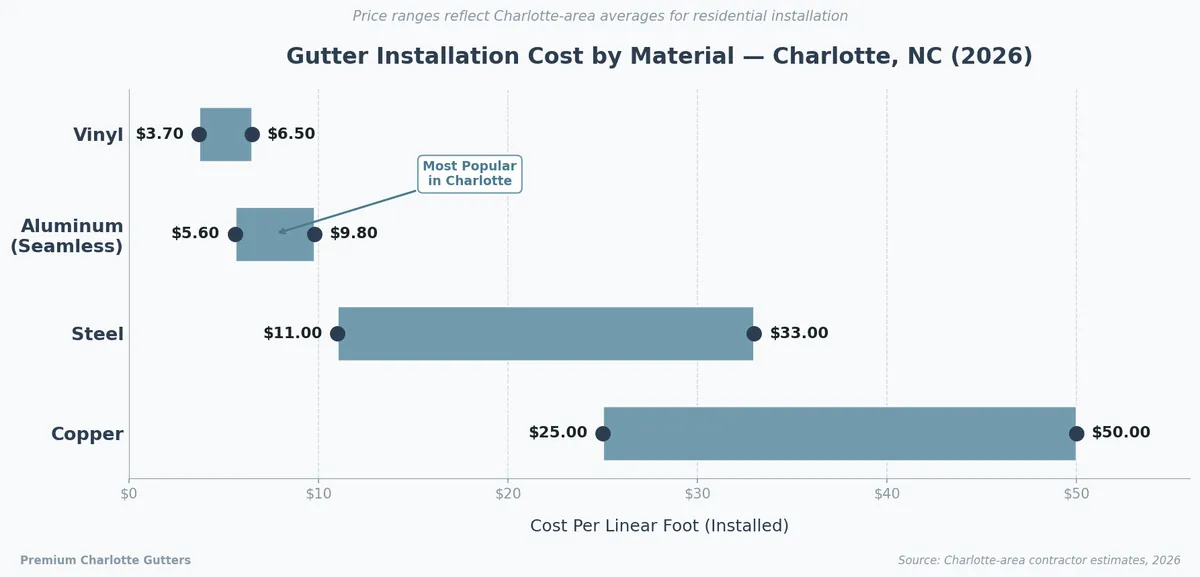
The table below provides a quick-reference snapshot of gutter installation pricing across the four most common materials available in the Charlotte market. These figures represent installed cost per linear foot, including labor, materials, and standard hangers.
| Material | Cost Per Linear Foot | Average Per LF | Notes |
|---|---|---|---|
| Aluminum Seamless | $5.60 – $9.80 | ~$8.00 | Charlotte standard; 5" and 6" profiles |
| Vinyl | $3.70 – $6.50 | ~$5.10 | Not recommended for Charlotte climate |
| Steel | $11 – $33 | ~$16.00 | Heavy-duty; storm and debris resistance |
| Copper | $25 – $50 | ~$35.00 | Premium; historic homes, 50+ year lifespan |
For a typical Charlotte home requiring 150 to 200 linear feet of guttering, aluminum installation runs between $840 and $1,960. A full gutter replacement project that includes tearing down the old system averages approximately $12 per linear foot once removal, disposal, and any minor fascia touch-ups are factored in.
Quick math: A 1,800-square-foot ranch in neighborhoods like Starmount or Cotswold typically needs 140 to 170 linear feet of guttering. At the aluminum average of $8 per linear foot, that project lands between $1,120 and $1,360 before add-ons like guards or downspout extensions.
Cost Breakdown by Material
Material selection is the single largest variable in any gutter installation estimate. Each option carries distinct advantages, drawbacks, and price points that make it better suited for certain Charlotte neighborhoods and property types.
Aluminum Seamless — $5.60 to $9.80 Per Linear Foot
Aluminum seamless gutters dominate the Charlotte market for good reason. At an average installed cost of around $8 per linear foot, they offer the strongest balance of performance, longevity, and affordability. Available in both 5-inch standard and 6-inch oversized profiles, aluminum handles Charlotte's 43 to 45 inches of annual rainfall without issue.
The "seamless" designation matters. Unlike sectional systems pieced together from pre-cut lengths, seamless aluminum gutters are roll-formed on-site to the exact dimensions of each roofline. That means fewer joints, fewer leak points, and a cleaner finished appearance. Most Charlotte contractors carry aluminum in 30 or more color options with baked-on enamel finishes that resist fading and chalking.
Aluminum does not rust, tolerates temperature swings from summer highs above 90 degrees to occasional winter freezes, and typically lasts 20 to 30 years with routine maintenance. For the vast majority of Charlotte residential properties, aluminum seamless remains the recommended choice. More on material comparisons in the seamless gutters guide.
Vinyl — $3.70 to $6.50 Per Linear Foot
Vinyl gutters carry the lowest upfront price tag in the market, averaging around $5.10 per linear foot installed. That affordability, however, comes with a significant caveat for Charlotte homeowners: vinyl is generally not recommended for this climate.
Charlotte's humid subtropical weather creates a hostile environment for vinyl gutter systems. Sustained UV exposure during long, hot summers causes the material to become brittle and fade. Temperature cycling between summer heat and winter cold leads to expansion and contraction that loosens joints over time. High humidity accelerates the degradation of adhesives and seals at connection points.
Vinyl gutters typically last only 10 to 15 years in the Charlotte area — sometimes less on south-facing rooflines that absorb maximum sun exposure. When factoring in the cost of premature replacement, vinyl often proves more expensive than aluminum over a 20-year ownership horizon. For a rental property or short-term flip, the lower upfront cost may be defensible. For a primary residence, it rarely is.
Steel — $11 to $33 Per Linear Foot
Galvanized and stainless steel gutters occupy the mid-to-upper price tier at an average of around $16 per linear foot. Steel's primary selling point is structural strength — it handles heavy debris loads, resists denting from fallen branches, and stands up to the kind of severe thunderstorms and occasional ice events that Charlotte experiences each year.
The wide price range reflects the difference between galvanized steel (lower end) and stainless steel (upper end). Galvanized steel carries a zinc coating that resists corrosion but will eventually wear through after 15 to 25 years, at which point rust becomes a factor. Stainless steel eliminates the rust concern entirely but at a substantial cost premium.
Steel gutters are heavier than aluminum, which means they require sturdier mounting hardware and more robust fascia boards. Installation labor costs tend to run higher as a result. Properties in wooded Charlotte-area lots — particularly in areas like Lake Norman, Ballantyne, and Providence Plantation where mature hardwoods drop heavy limbs during storms — may benefit from steel's added durability.
Copper — $25 to $50 Per Linear Foot
Copper gutters sit at the top of the price spectrum, averaging $35 per linear foot installed. They are a premium product for premium properties, and in Charlotte, that typically means the historic neighborhoods of Dilworth, Myers Park, and Eastover — areas where Charlotte's historic district guidelines may influence material choices — and where architectural character commands a higher investment.
The appeal of copper extends beyond aesthetics, though the visual impact is undeniable. New copper starts as a bright, polished metal and gradually develops a distinctive green patina over several years — a weathering process that many homeowners and historic preservation boards consider an asset rather than a deficiency. That patina also forms a protective oxide layer that extends the material's functional lifespan well beyond 50 years.
Copper requires no painting, resists corrosion without coatings, and can be soldered at joints for a completely watertight system. The tradeoff, beyond price, is that copper gutters demand specialized installation skills. Not every gutter contractor in the Charlotte market handles copper work, so the pool of qualified installers is smaller and lead times may be longer.
Need a Gutter Installation Estimate?
Get a transparent, no-obligation quote for any material or project size in the Charlotte metro area.
(980) 304-3538 Call For Free EstimateAdditional Cost Factors
The per-linear-foot material cost is the starting point, but several project-specific variables can push a final invoice higher. Understanding these factors before requesting estimates helps set realistic budget expectations and makes it easier to compare bids on an apples-to-apples basis.
- Number of stories: Two-story homes add 20 to 30 percent to the installation cost compared to single-story properties. The additional height requires taller ladders or scaffolding, longer downspout runs, and more time on each section. Three-story homes and steep-pitch rooflines push that premium even higher.
- Roof complexity: Charlotte neighborhoods like Dilworth and Myers Park are known for homes with dormers, multiple roof valleys, and intricate rooflines that increase the linear footage of guttering required and add complexity to corner transitions. Each inside or outside corner adds labor time and material.
- Old gutter removal: Tearing down an existing gutter system typically costs $1 to $3 per linear foot. Some contractors include this in their replacement estimates; others list it as a separate line item. Always confirm which approach a particular estimate uses.
- Fascia and soffit repair: Once old gutters come down, hidden damage often reveals itself. Rotted fascia boards or deteriorated soffit panels need to be addressed before new gutters go up. Fascia repair runs $9 to $34 per linear foot depending on the material and extent of the damage. Skipping this step to save money virtually guarantees premature failure of the new gutter system.
- Downspout count and routing: Most estimates include a standard number of downspouts based on the roofline layout. Additional downspouts, longer runs, or underground drainage tie-ins increase the total cost. Downspout installation typically runs $6 to $40 per linear foot depending on material and routing complexity. Details are available on the downspout services page.
- Gutter guard add-on: Adding gutter guards at the time of installation is more cost-effective than retrofitting them later. Guard systems range from $3.10 to $18 per linear foot depending on the type — basic mesh screens at the low end, micro-mesh or reverse-curve systems at the high end. For properties surrounded by mature trees, guards can significantly reduce long-term cleaning costs.
- Permits: Under North Carolina's licensing threshold, standalone gutter installation projects that fall below $40,000 do not require a building permit. Virtually all residential gutter jobs in Charlotte come in well under that figure, so permitting is a non-issue for the overwhelming majority of homeowners.
Charlotte vs. National Gutter Costs
Charlotte gutter installation pricing runs roughly in line with the national average, which may come as a surprise given the city's rapid growth over the past decade. Several regional factors keep costs from escalating beyond national benchmarks.
Charlotte's overall cost of living sits approximately 15 percent below the national median, a trend supported by Bureau of Labor Statistics data for the metro area, which translates into moderate labor rates compared to markets like the Northeast, Pacific Northwest, or coastal California. The Charlotte metro's large and competitive contractor pool also helps keep pricing stable — there is no shortage of gutter installation companies operating in the area, which limits the ability of any single provider to charge a significant premium.
Material costs, meanwhile, are largely standardized across the country. Aluminum coil stock, steel sheets, and vinyl components are commodity products that do not vary dramatically by region. The labor component is where Charlotte homeowners see a modest advantage, though that advantage narrows on complex projects that require more specialized skills.
Seasonal weather patterns in Charlotte do not create the same urgency-driven pricing spikes seen in markets with harsh winters or extreme storm seasons. While demand does pick up in spring and fall, it rarely reaches the point where contractors levy meaningful surge pricing.
How to Get the Best Price
Getting the best value on a gutter installation in Charlotte does not mean hunting for the cheapest bid. It means understanding what separates a quality installation from a cut-rate one, and knowing the right questions to ask before signing anything.
- Get at least three quotes. This is the single most effective way to ensure fair pricing. Three estimates from different contractors provide enough data points to identify outliers — both suspiciously low bids and inflated ones.
- Compare footage measurements. Every contractor should independently measure the home. If three estimates show significantly different linear footage totals, that is a red flag. The measurement determines the entire cost basis, so accuracy matters.
- Ask about aluminum gauge. Standard residential aluminum gutter stock is 0.027 inches thick. Some contractors offer a premium gauge of 0.032 inches, which provides greater rigidity and dent resistance — a worthwhile upgrade for properties with heavy tree cover or exposure to wind-blown debris. Several national providers have begun promoting thicker-gauge options as a differentiator. Make sure estimates specify which gauge is being quoted.
- Verify hanger spacing. Gutter hangers (the brackets that secure the gutter to the fascia) should be spaced every 24 to 36 inches. Wider spacing saves the installer time and money but creates weak points that sag over time, especially under the weight of debris and standing water. Some Charlotte contractors space hangers at 24 inches as standard; others default to 36. Closer spacing is better.
- Ask about warranties. Material warranties from the manufacturer (typically 20 to 25 years on aluminum) are separate from labor warranties offered by the installer. A quality contractor stands behind their workmanship for at least 2 to 5 years. Get both warranty terms in writing before work begins.
- Explore financing options. Several larger gutter companies serving the Charlotte market offer financing programs that spread the cost over 12 to 60 months. For homeowners tackling a full gutter installation or replacement alongside guard systems, financing can make a higher-quality product financially accessible.
- Consider timing. Fall and late spring are peak seasons for gutter work in Charlotte, driven by leaf drop and spring storm damage respectively. Scheduling during winter or late summer may yield slightly lower pricing or faster availability, as contractor schedules tend to be less compressed during those windows.
Other Charlotte Gutter Service Costs
Gutter installation is only one piece of the overall gutter maintenance equation. The table below outlines typical Charlotte-area pricing for related services that homeowners may need alongside or instead of a full installation.
| Service | Typical Cost Range | Details |
|---|---|---|
| Gutter Cleaning | $70 – $300 | Per visit; varies by home size and debris volume |
| Gutter Repair | $150 – $1,500 | Leak sealing, rehanging, section replacement |
| Gutter Guards | $3.10 – $18/LF | Mesh, micro-mesh, reverse-curve, foam inserts |
| Downspouts | $6 – $40/LF | Installation, extensions, underground routing |
For homeowners whose existing gutters are in decent structural condition but underperforming, a targeted repair may be the more cost-effective path compared to a full replacement. Sagging sections, isolated leaks at seams, and damaged downspout connections can often be resolved for a fraction of the cost of new gutters.
Regular cleaning — at least twice per year for most Charlotte homes, and three to four times for properties near heavy tree cover — remains the single best way to extend the life of any gutter system and avoid costly water damage to fascia boards, foundations, and landscaping.
Bottom line: A well-planned gutter installation in Charlotte typically runs between $840 and $1,960 for aluminum on a standard home. Material upgrades, gutter guards, and site-specific factors like two-story access or fascia repair can push the total higher, but competitive pricing in the Charlotte market means homeowners are unlikely to face the inflated estimates common in higher-cost metro areas. Getting multiple quotes, understanding the specification differences between bids, and timing the project during a slower season all contribute to a better outcome — both financially and in terms of the quality of work delivered.
Have questions about gutter costs for a specific Charlotte property? The FAQ page covers the most common homeowner questions, or call directly for a project-specific estimate.